RoughNeck - Custom Boards and Seamless Integrations
In the complex and demanding world of industrial operations, a "one-size-fits-all" approach to computing simply doesn't work. This is where Acura Embedded Systems truly excels, particularly with our flagship Roughneck series. Our unparalleled ability to integrate custom boards, specialized decoders, and various communication modules directly into our rugged computers is a game-changer for our clients. This section will explain what these custom integrations entail, why they are crucial for our customers, and how Acura's innovative approach eliminates pain points and enhances operational efficiency.
1. The Need for Custom Boards: Beyond Standard Functionality
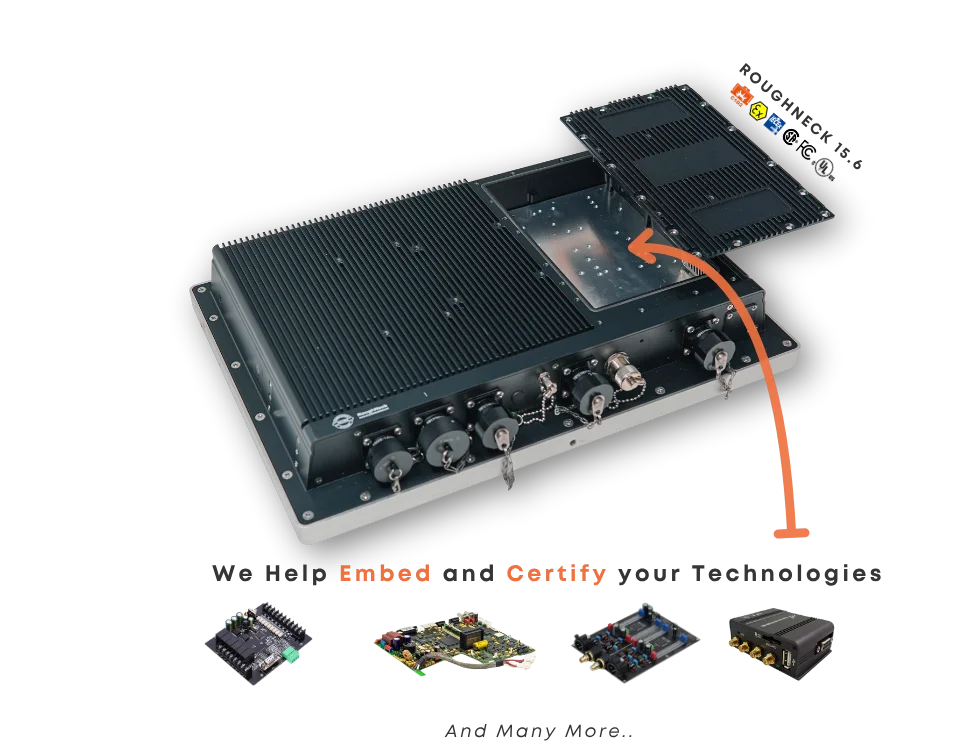
Industrial environments often rely on very specific, proprietary, or legacy equipment that requires unique ways of communicating with a computer. Standard off-the-shelf computers are not designed for this. Custom boards are specialized electronic circuit boards that perform a very particular function, acting as a bridge between the computer and these unique industrial tools or sensors.
Why are they so important to our customers?
Solving Unique Problems: Every drilling rig, every mine, every factory might have a slightly different setup or a proprietary tool. Custom boards allow our computers to seamlessly interact with these specific pieces of equipment.
Consolidation: Historically, customers would have separate external boxes for each of these functions, leading to a cluttered workspace, numerous cables, and multiple points of failure. Integrating these custom boards directly into our computer consolidates everything into one robust unit.
Enhanced Performance & Reliability: By bringing these functions inside a sealed, rugged computer, we eliminate fragile external connections and ensure consistent performance, even in harsh conditions.
2. Key Types of Custom Boards and Modules Acura Integrates
Acura's expertise covers a wide array of specialized board integrations:
MWD Decoders (Measurement While Drilling Decoders):
What they are: MWD decoders are crucial electronic boards that convert analog signals (pulses or pressure waves) sent from downhole tools (deep inside the drill bit) into digital data that a computer can understand and process. These analog signals carry vital information about the drilling process, such as temperature, pressure, and geological formations.
Why they are important: For directional drilling companies, real-time access to this precise data is essential for making immediate adjustments to the drill path, optimizing performance, and ensuring safety. Without a decoder, the raw analog data is unusable by modern software.
Acura's Innovation: Acura broke barriers by integrating these decoders directly inside our Roughneck computers. Previously, customers used external "decoder boxes" (like those from Norelis, a UK-based company now under Gordon Technologies). This internal integration eliminated an extra box and its insecure USB connection. Furthermore, with the increased processing power of our Roughneck systems, Acura pioneered the integration of dual decoder boards. This allows the computer to process two pulses simultaneously, effectively doubling the data processing speed. This gives operators much faster, real-time insights, enabling quicker and more precise maneuvering of the directional drill.
DAC Cards (Data Acquisition Cards):
What they are: DAC cards are electronic boards designed to collect data from various sensors and instruments in the field. They act as an interface, converting analog signals from sensors (like temperature, pressure, or vibration sensors) into digital data that the computer can analyze.
Why they are important: They are vital for monitoring environmental conditions, equipment status, and process parameters in real-time, providing critical data for operational decisions and predictive maintenance.
PLC Controllers (Programmable Logic Controllers):
What they are: PLCs are industrial computers that control automated processes, such as machinery on a factory floor, valves in a pipeline, or components of a drilling rig. They receive inputs from sensors and send outputs to actuators (like motors or lights) to control operations.
Why they are important: Integrating a PLC controller directly into our computer allows for a consolidated control system, simplifying automation architectures and enhancing the reliability of machine control in harsh environments.
Modems (4G/LTE, 5G, 900 MHz Radio):
What they are: Modems are devices that enable computers to send and receive data over various communication networks.
Why they are important: For remote industrial sites like oil rigs, reliable data transmission to central operations centers is crucial. This enables remote monitoring, diagnostics, and control, even when traditional wired internet is unavailable or restricted.
Acura's Innovation:
900 MHz Radio (Microhard Modems): This refers to specialized radio modems operating on the 900 MHz frequency. While their data speed is relatively slower (around 1 Mbps), this frequency has unique propagation characteristics. It is excellent for penetrating metal structures and "bouncing" signals around obstacles, making it highly reliable for communication in complex industrial settings where Wi-Fi signals might struggle. Acura pioneered integrating Microhard 900 MHz modems directly inside our computers. Previously, these were external "boxes" that customers had to connect, adding clutter and cost. Our internal integration eliminated these bulky and expensive external units, simplifying deployments and reducing points of failure.
4G/LTE & 5G Cellular Modems: Acura integrates 4G/LTE modules (with 5G capable modems) directly into our computers. This provides crucial mobile broadband connectivity, allowing service companies to remotely monitor and access their equipment on rigs, even when the rig's internal network is restricted for security reasons. This was a key solution provided to companies like Erdos Miller.
Gateways:
What they are: Gateways act as a bridge between different communication networks or protocols. They translate data between different systems, allowing them to communicate with each other.
Why they are important: In complex industrial setups, various devices might use different communication standards. Gateways ensure seamless data flow across these disparate systems. For example, in Managed Pressure Drilling (MPD) applications (a market Acura entered with Premium Oilfield Services), clients needed various gateways to control fluid flow during drilling. Acura designed solutions to integrate these gateways internally.
3. The Power of Internal Integration: Why It's a Game-Changer
Acura's ability to integrate these specialized boards and modules directly into the Roughneck (and other platforms) offers profound benefits:
Ultimate Consolidation: The most immediate benefit is the elimination of "too many boxes, too many cables." What was once a cluttered setup with multiple external devices becomes a single, streamlined, integrated unit.
Reduced Points of Failure: Every external connection, every separate box, is a potential point of failure. By integrating components internally, we drastically reduce the number of connections and external hardware, leading to significantly higher system uptime and reliability.
Enhanced Security: With the main computing unit (containing sensitive data and proprietary boards) hidden or secured within the vehicle (e.g., in the trunk of a police car, as with the Niagara Regional Police Service solution), only the monitor is visible. This makes the system far more secure against theft or tampering compared to easily removable laptops.
Simplified Deployment & Maintenance: A single, integrated unit is easier to transport, install, and maintain in the field. This saves time and labor costs for our customers.
Tailored Performance: The solution is precisely matched to the customer's unique software, sensors, and operational workflow, optimizing performance and eliminating compatibility issues.
4. Case Study Highlight: Eliminating Clutter for Cheetah Oilfield Supply
A prime example of Acura solving a customer's pain point through custom board integration is our work with Cheetah Oilfield Supply.
The Challenge: Cheetah Oilfield, a casing company, uses a specialized torque-measuring device to ensure precise torque is applied when adding pipes during drilling. This device had its own external control box and required separate power cables, adding to the clutter and complexity on the rig.
Acura's Solution: Acura integrated the control logic for Cheetah's torque-measuring device directly into our Roughneck computer. We also engineered a solution to provide AC power and data directly from the Roughneck to Cheetah's device.
The Impact: This eliminated the need for Cheetah to bring separate, long power cables for their device. The Roughneck became a consolidated hub, controlling the torque measurement via Cheetah's software running on our computer, and simultaneously powering and receiving data from their specialized tool. This significantly simplified their setup, reduced cable clutter, and enhanced operational efficiency and safety on the rig.
Acura's expertise in custom board integration is not just about technical capability; it's about deeply understanding our customers' operational challenges and engineering bespoke solutions that deliver tangible improvements in efficiency, safety, and reliability.
There are no comments for now.
to be the first to leave a comment.